/
Journal cover: Toxicon

Toxicon

2025 · v. 262

Immunobiologicals and 3Rs LEAD AUTHOR

Reducing time in lethality assay (LD50) for Bothrops jararaca and Crotalus durissus terrificus venoms and lethality neutralizing assay (ED50) for their respective antivenoms: A 3Rs-based retrospective data validation

Authors: Pereira-Júnior, A. A.; Lima, F. H. D. M.; Martins, I. F.; Silva, R. S. F.; Lucas, E. P. R.
518 Historical Assays
> 0.96 Agreement (Lin CCC)
98.5% to 100% Decision Accuracy
50% (24h vs 48h) Time Reduction
Acessar Artigo Original (DOI) ↗
Editorial note: This commented synthesis highlights the scientific aims, analytical methodology, and implications of the study for academic dissemination. The complete original publisher-formatted text is accessible via the official DOI link above.

Context and Scientific Challenge

Official regulatory quality control of antivenoms in Brazil and WHO guidelines historically mandated a 48-hour observation window for mouse mortality endpoints in lethality (LD50) and neutralization (ED50) bioassays. However, prolonging observation past peak mortality causes unnecessary animal distress if biological endpoints stabilize much earlier.

Study Design and Methods

Exhaustive retrospective curation of 518 regulatory assays performed from 2009 to 2023 at INCQS/Fiocruz, covering 334 ED50 and 27 LD50 assays for Bothrops jararaca, and 134 ED50 and 23 LD50 assays for Crotalus durissus terrificus. Analyses employed Kaplan-Meier survival curves, non-parametric Bland-Altman agreement analysis, Lin’s Concordance Correlation Coefficient (CCC), and diagnostic confusion matrices with weighted Kappa.
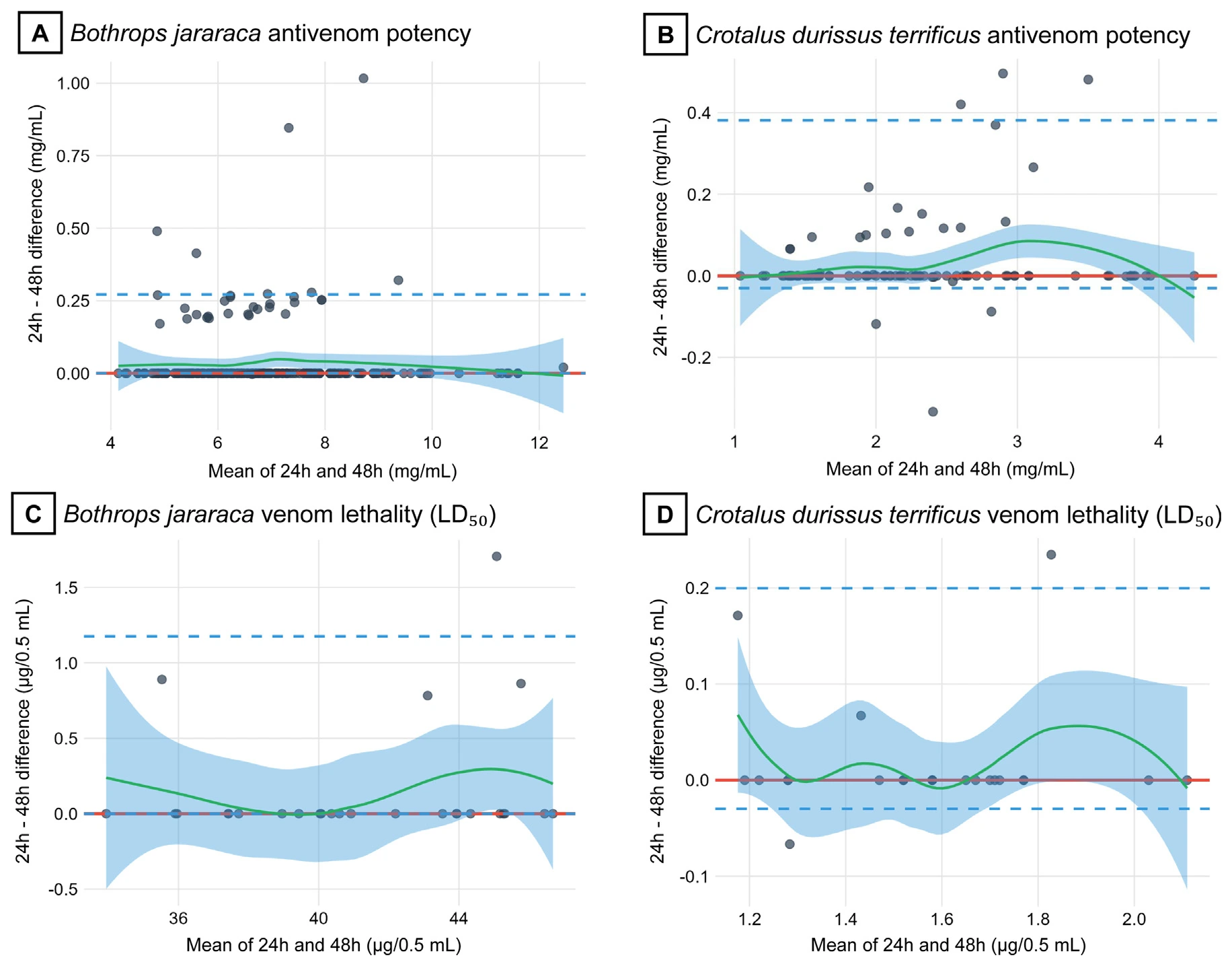
Non-parametric Bland-Altman plots (24h vs. 48h) for antivenom potency (A–B) and venom lethality (C–D) of B. jararaca and C. d. terrificus.
Fig. 1: Non-parametric Bland-Altman plots (24h vs. 48h) for antivenom potency (A–B) and venom lethality (C–D) of B. jararaca and C. d. terrificus.

Key Findings and Evidence

  • Over 98% of all cumulative deaths occurred within the first 24 hours: 99.02% for Bothrops antivenom, 98.04% for Crotalus antivenom, 98.43% for Bothrops venom, and 98.89% for Crotalus venom.
  • Near-perfect statistical concordance between 24h and 48h potency estimates: Lin’s CCC was 0.969 for Bothrops antivenom and 0.997 for Crotalus antivenom.
  • Batch release diagnostic accuracy was 100% for C. d. terrificus (Kappa = 1.00) and 98.50% for B. jararaca (Kappa = 0.98; only 6 discordant results out of 334 assays, all near fiducial decision margins).
  • Median potency and lethality values at 24h and 48h were practically identical: Bothrops ED50 was 4.77 vs. 4.76 mg/mL; Crotalus ED50 was 6.56 vs. 6.50 mg/mL.

Regulatory Implications and Practical Impact

The evidence establishes the first ISO/IEC 17025-compatible statistical justification for pharmacopeias to reduce official observation times from 48h to 24h, cutting animal distress by 50% while fully safeguarding antivenom batch safety in public healthcare.

INTERACTIVE TELEMETRY & 3RS VALIDATION

Kaplan-Meier Survival Curves & Diagnostic Matrix (24h vs. 48h)

Toxicon (2025) · Dados Publicados Reais

Equivalência 24h vs 48h em Titulação de Soros e Venenos (3Rs)

Redução de 50% no Tempo Animal (518 Ensaios)

Validação bioestatística retrospectiva (2009–2023) comprovando que o desfecho letal se concentra em mais de 98% nas primeiras 24 horas, permitindo antecipar a leitura de 48h para 24h sem perda de acurácia regulatória e poupando sofrimento animal sob diretrizes 3Rs.

Concentração de Óbitos em ≤ 24 horas:99.02% (4954 de 5003 óbitos)
≤24h (99.0%)
Óbitos em ≤ 24h: 4954Óbitos tardios (24–48h): 49
Mediana ± MAD
24h: 6.66 mg/mL
48h: 6.64 mg/mL
Coeficiente de Lin (CCC)
0.997
IC 95%: [0.996–0.998]
Acurácia Diagnóstica
98.5%
Kappa: 0.98 (Quase Perfeito)
Constante Km (24h vs 48h)
0.54 vs 0.53
Conforme Farmacopeia
Pereira-Júnior, A. A. et al. Toxicon, v. 262, p. 108358, 2025.DOI