Context and Scientific Challenge
Maternal smoking during lactation exposes infants to nicotine during critical brain growth and synaptic maturation. We investigated whether early lactational nicotine programs persistent behavioral and neurochemical vulnerability to adult chronic stress (two-hit model).
Study Design and Methods
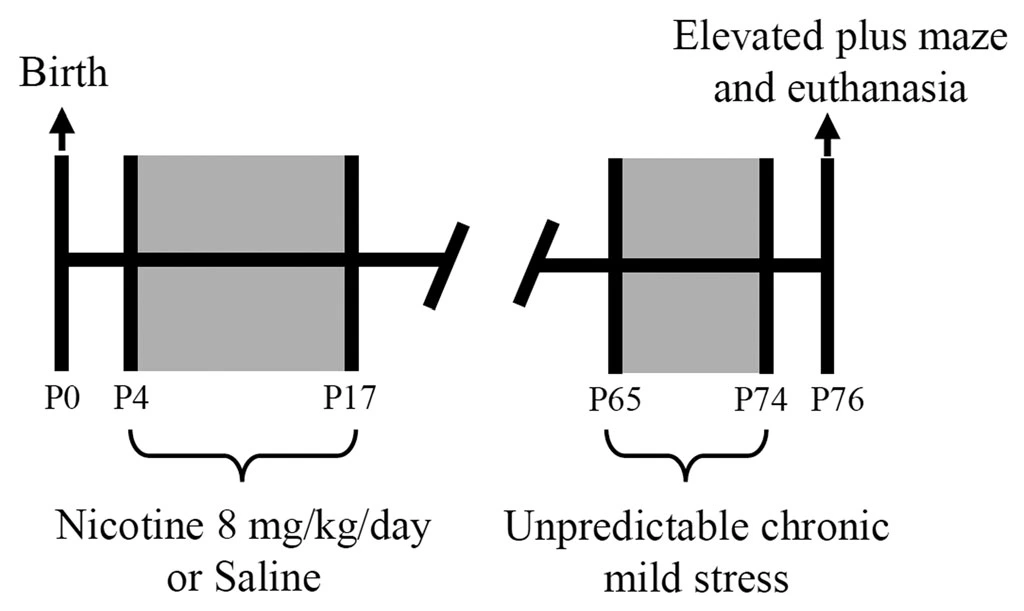
Lactating Swiss dams received nicotine (8 mg/kg/day) or saline via subcutaneous osmotic mini-pumps from P4 to P17. Female offspring were weaned at P21 and maintained drug-free until adulthood (P65). At P65, cohorts underwent 10 days of UCMS. Endpoints at P76 included anxiety behavior (EPM), plasma corticosterone, ELISA BDNF, and Western blot synaptic markers across four brain regions.
Key Findings and Evidence
- Persistent anxiety phenotype: nicotine-exposed adult females exhibited reduced open-arm exploration and significant elevation in self-grooming behavior (p < 0.05).
- Regional neurotrophic suppression: significant drop in BDNF within cerebellum (-28%) and striatum (-34%), with spared hippocampal levels.
- Synaptic reorganization: compensatory upregulation of cerebellar PSD-95 and synapsin I in nicotine-exposed stressed females (p < 0.05).
- Brainstem deficits: long-lasting downregulation of synaptophysin and PSD-95, pointing to programmed impairment in central autonomic and relay circuits.
Regulatory Implications and Practical Impact
Confirms that nicotine exposure restricted to lactation leaves lasting neurochemical and behavioral scars into female adulthood, underscoring the vital public health necessity of tobacco cessation interventions for nursing mothers.